Published on
Jan 28, 2026
Private, Local vs. Cloud-Based AI for Therapy Documentation
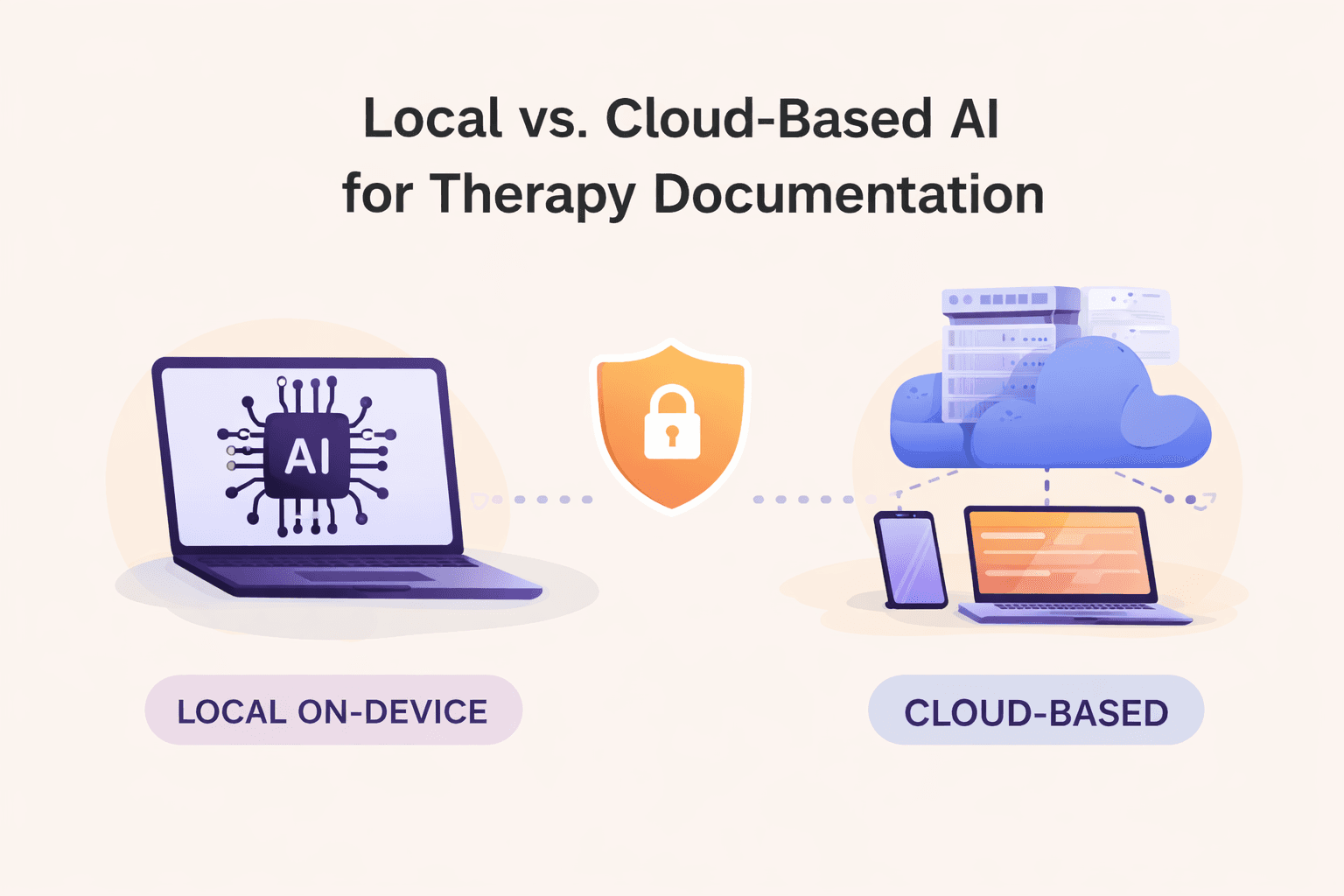
Artificial intelligence is increasingly being introduced into clinical documentation workflows, including transcription, progress note drafting, and session summaries. For therapists, psychologists, and other mental health professionals, the core question is no longer whether AI can assist with documentation—but how that assistance is implemented, and where sensitive data is processed.
One of the most important distinctions in this space is between local (on-device) AI and cloud-based AI systems.
Cloud-Based AI: Convenience with Tradeoffs
Most AI-powered documentation tools today rely on cloud infrastructure. In these systems, session audio or text is transmitted from the clinician’s device to external servers for processing and storage. Cloud-based approaches offer clear advantages: centralized updates, cross-device access, and relatively low local hardware requirements.
However, for clinical documentation, cloud-based AI introduces several considerations:
Data transmission risk: Client information must leave the clinician’s device, even if encrypted.
Third-party exposure: Processing often involves external vendors, subcontractors, or model providers.
Compliance complexity: Clinicians remain responsible for ensuring alignment with professional obligations and applicable privacy regulations.
Ongoing trust dependency: Continued privacy relies on the policies, security posture, and business practices of the service provider.
Even when cloud vendors advertise compliance (e.g., HIPAA-aligned services), clinicians are often required to rely on contractual assurances rather than direct technical control.
Relevant references:
U.S. Department of Health & Human Services – HIPAA and cloud computing:
https://www.hhs.gov/hipaa/for-professionals/special-topics/cloud-computing/index.html
APA Guidelines on the Practice of Telepsychology:
Local, On-Device AI: Control by Design
Local AI systems take a different approach. Instead of sending data to external servers, all processing occurs directly on the clinician’s device. Audio, text, and generated drafts never leave the local environment.
This architecture offers several practical and ethical advantages for therapy documentation:
No external data transmission: Client data remains on the clinician’s computer.
Reduced attack surface: Eliminates risks associated with remote servers or breaches.
Offline operation: Documentation workflows are not dependent on internet access.
Clear data ownership: Clinicians maintain full custody and control of records.
Lower interpretive risk: Local tools are more easily constrained to documentation support rather than analysis or decision-making.
For clinicians who prioritize privacy, professional autonomy, and minimal data exposure, local-first systems align more closely with longstanding principles of confidentiality and record stewardship.
AI as Documentation Support, Not Clinical Judgment
Regardless of architecture, it is critical to distinguish documentation assistance from clinical decision-making. Ethical use of AI in therapy contexts requires that tools support administrative tasks—such as drafting, organizing, or formatting notes—without interpreting client material, diagnosing conditions, or influencing treatment decisions.
Professional guidance consistently emphasizes that responsibility for clinical judgment remains with the practitioner, not the tool (APA, CPA, and similar bodies).
Canadian Psychological Association – Ethical Use of Technology
Choosing the Right Approach
When evaluating AI documentation tools, clinicians may want to ask:
Where is my data processed?
Who has technical access to it?
What happens if the service changes policies or ownership?
Can I use the tool without internet access?
Does the system clearly limit itself to documentation support?
There is no single solution that fits every practice, but understanding the architectural difference between local and cloud-based AI is essential for informed decision-making.
A Local-First Option
Some newer tools are intentionally designed around local-only processing to address these concerns. For example, SessionWise is a macOS application built to run entirely on-device, with no servers, no accounts, and no data collection. All transcription, drafting, and storage occur locally on the clinician’s Mac, allowing AI assistance while keeping client information fully under the clinician’s control.
For therapists exploring AI-assisted documentation while remaining cautious about privacy and professional responsibility, local-first approaches represent a meaningful alternative worth considering.
Learn more at https://www.sessionwise.app
